History’s Different Facets: Confronting New Perspectives in Vietnam

Published on April 7, 2014 in Young & Global Magazine:
War Remnants Museum

Here’s a question you probably weren’t asked in history class: Who won the American War? If you’re a little confused as to which war I’m referring to, you’re probably not Vietnamese. To the rest of the world, the prolonged struggle from 1959 to 1975 between communist-backed northern Vietnam and the United States-supported south is commonly known as the Vietnam War. A recent visit to Ho Chi Minh City (formerly Saigon) taught me that history would never be an easy topic to confront or discuss abroad, but that it is worth trying.

A great many Westerners know little about the history of Vietnam before or after this gruesome conflict. The Southeast Asian nation makes a single, traumatizing cameo in American history books, and students will rarely learn about Vietnam from any other angle. While it would be ideal if our education about other nations were more holistic, it isn’t unusual or even remarkable that Americans are taught about the world mainly through our own country’s actions and interactions.

However, it is often forgotten—as in the case of Vietnam—that the foreign players in our nation’s history have long and rich backstories of their own. This is why travel continues to be vital in an era when every nation on earth is represented by galleries of photos on the internet and summaries on Wikipedia. When we go out into the world, we relocate not just our physical bodies, but our minds as well. We are granted the ability to hear these countries’ histories as narrated from their points of view.

This can be frustrating. The history of the world you learned in school will likely be quite different from the recounting you hear abroad, especially when it comes to conflict. It may be tempting to enforce your own nation’s version of events as the “correct” one, but it is important to remember—whether you travel the world or not—that there will never be one entirely accurate account of history. Retellings vary from textbook to textbook, city to city, and country to country. Authors and historians make assumptions, mistakes, and oversights, just like the rest of us. In some cases, you will come across obvious biases or misrepresentations—such as in North Korea’s museums, which feature a clearly false retelling of world events—but most variations will not be so blatant.

History is a collection of human experiences, and each person experiences the world through a unique lens. This lens is heavily influenced by cultural norms and heritage, and many people are unaware of how deeply embedded these influences are. For example: a person who grows up in a powerful, independent country will learn (through formal teachings and subliminal cultural osmosis) to judge the world differently than one who grows up in a country influenced by foreign invasions and occupation. A person who grows up with more than enough to eat is going to appraise a meal differently than a person who grows up with barely enough. A nation that venerates honesty is going to reflect on war differently than a nation that venerates societal harmony.
Modern Propaganda

It is easy to become emotional when faced with an unflattering version of history, particularly if you are American or British or Japanese. You may become angry with your own country, as perhaps you wonder why your teachers failed to cover certain historical events in class. Or you may direct your anger at the country you’re visiting, as perhaps you believe this retelling of events to be unfair. You may feel the urge to completely write off this account of the past, but by doing so you sacrifice a tool for gaining insight into the nation that authored the account. Instead of reacting blindly to this unattractive portrayal of your country, ask yourself why this portrayal exists in the first place.

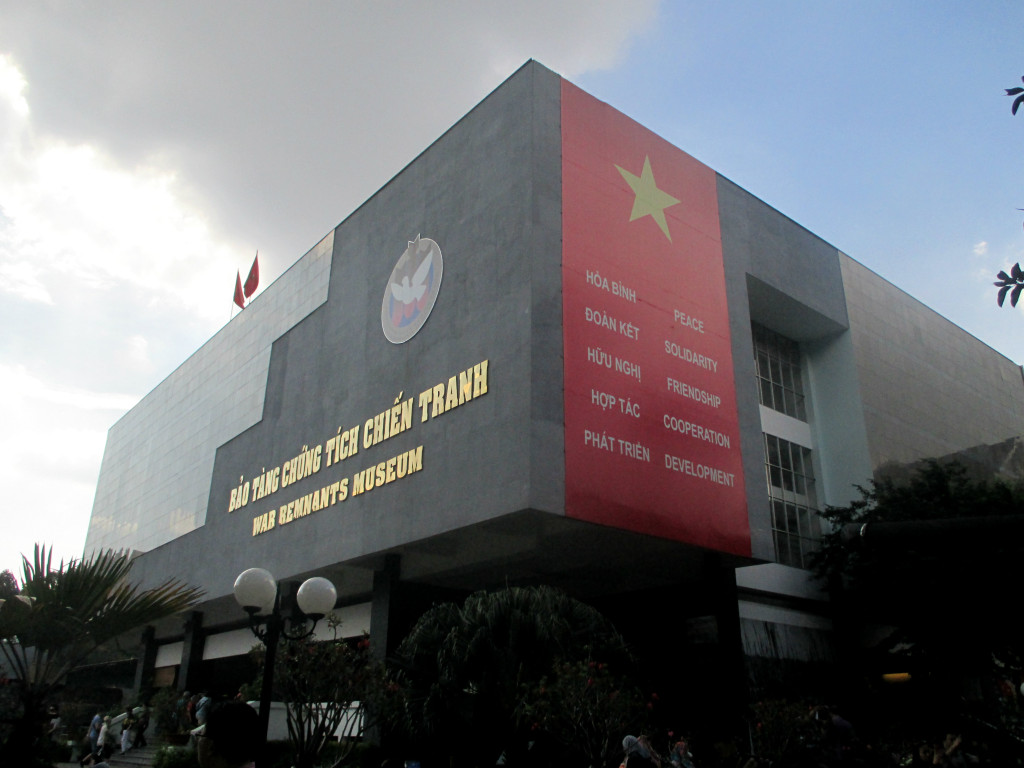
The War Remnants Museum in Ho Chi Minh City attracts approximately half a million visitors annually and has become one of the city’s most popular tourist sites for foreigners. I left the museum in tears, shaken and bewildered by the unforgivingly vivid photographs of American soldiers smiling next to dismembered men, the piles of slaughtered women, and the children torn apart by U.S. bombs. It might be tempting to decry the War Remnants Museum as propagandist. After all, the museum depicts American soldiers as genocide machines who invaded this country for no reason, and there is almost no mention of any of the Vietnamese-on-Vietnamese atrocities that occurred. But it is worth mentioning that many of the photographs are from vetted American sources and it is worth considering why the Vietnamese government would choose to portray the conflict in such a manner. What might their objective be? And what does it say about them?

By framing this part of history in this way, the War Remnants Museum presents a national Vietnamese identity via its suffering. As a country literally and emotionally split in two by a bloody conflict, a unified identity was an uncertain reality, one that needed to be reinforced. And how better to unite people than to depict them with a common enemy? But this enemy isn’t the United States, however much the violent exhibitions may suggest that it is.

The ground floor of the museum is devoted to the international antiwar movement and the museum does take care to include Americans among the posters, newspaper snippets, and photographs: a B-52 pilot who defected, protests in Washington DC, quotes from Martin Luther King Jr., and so on. The Vietnamese government may want its population to forget how divided it once was, but the last thing it wants is to incite its people into another imbroglio. Thus, while the museum has no qualms about demonstrating the gory actions of the United States, the enemy it wants visitors to remember and fear is the brutality of conflict. We are supposed to understand that ideologies may be grand and noble, but for the civilians on the ground, war is never anything but senseless and inhuman.

In this case, I agree with the choice to portray history this way, even though I left the War Remnants Museum bawling. Most high school history textbooks explore the macro trends that spurred international conflict but don’t expound upon the grisly trauma. And so, it is occasionally necessary to recall that history happened to people. However, while Ho Chi Minh City’s visceral museum is an indispensable reminder of the human element of war, it is also necessary to remember that no matter how mindlessly violent, no conflict is created in a vacuum. Vietnam’s suffering was real and important, but it was not the entire story.

The War Remnants Museum displays some of what occurred during the Vietnam War, actions and reactions, but not why it occurred. Framing the war as a foreign invasion streamlines Vietnam’s role in the struggle, but it subsequently oversimplifies the convoluted and interlocking series of world events that led up to the conflict in the first place. The Vietnam War was only possible due to the tense atmosphere of the Cold War, which cannot be understood without understanding World War II, which in turn cannot be understood without knowing World War I. To fully understand the reasons for the Vietnam War, one has to go back a full century to the beginning of French colonial rule in Southeast Asia. Empathy alone will not prevent history from repeating itself; we must be knowledgeable as well. Thus, it is important when considering a nation’s past to strike a balance between the causes of war as well as the effects. The global currents and ideological conflicts that take place on a macro scale are crucial to understanding why any individual human being would slaughter another.

History gives us context for what we encounter when we travel and while it empowers visitors to be understanding, equally important are your own eyes. Present-day Ho Chi Minh City is bustling and cheerful. The streets are replete with coffee shops, clothing stores, and petite hotels, in front of which women in nón lá (the traditional conical hat) sell baguette sandwiches, bowls of noodles, soft drinks, and fresh coconuts. Tourists are welcomed. When it rains, foreigners and locals hide under the same awnings and share incredulous laughs at the strength of the downpour. This is a far cry from the horrific depictions in the War Remnants Museum and from the somber history featured in Western textbooks. It is important to be aware of the complicated history and to feel personally how brutal conflict is, but it is also vital to take stock of the living, breathing present and to see how the soul and culture of a nation is so much more than just a past struggle.

Young & Global Magazine


“The Cave” & Peanut Butter Filled Chocolate Cookies

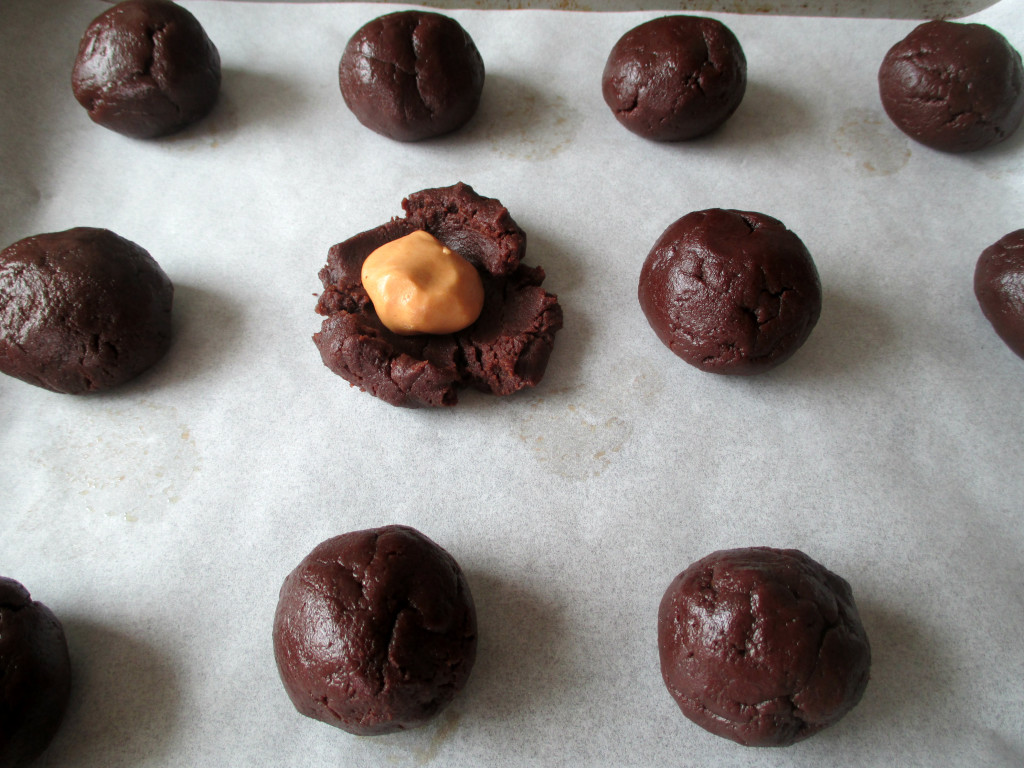
Recently posted over at PAPER/PLATES is my piece about Portuguese Nobel laureate José Saramago’s novel The Cave and why it inspired me to make peanut butter filled chocolate cookies. PAPER/PLATES is run by my friend Amina Elahi and features insightful literary reviews, interviews with food bloggers, and (the best part) recipes inspired by books.

Here’s a snippet of my post:

Reading The Cave is a very tactile experience. Since pottery is a key centerpiece of the novel, I knew I wanted to tackle a recipe that involved molding and sculpting material with my hands. However, I also wanted something with layers, as the modest appearance of the story cloaks a more complex exploration of humanity. These peanut butter filled chocolate cookies fit the bill. Much like the art of clay pottery and much like Saramago’s prose, this recipe requires patience and sometimes one or two tries to get down. But it’s hard to deny the satisfaction you feel upon completion. Be warned that these cookies are very rich; you WILL need a glass of milk to wash them down.

You can read the rest of the article and find the delectable cookie recipe HERE.

And make sure to check out the rest of the blog while you’re at it!

PAPER/PLATES

Potent Nostalgia: Cocktail Bars from Bygone Eras

Published on April 1, 2014 in the Singapore American Newspaper:

As I sipped a bliss-inducing Lemongrass Collins at the Miss Wong Cocktail Bar in Siem Reap, I wondered: Just what is it about bars devoted to the past? A speakeasy can now be found in just about every major city – from Raine’s Law Room in New York to Milk & Honey in London to R2 Supperclub in Tokyo. If I had to choose two reasons why, I would say it’s partly the nostalgia for a straightforward form of glamour and partly the luxurious, hand-crafted cocktails. For anyone bored of the standard mixer/spirit combo, these bars’ bespoke recipes, freshly-squeezed juices, and house infused liquors are a godsend. And while these drinks will obviously cost more than your average rum’n’coke, the rich ambience makes up for it. These bars invite you to step out of your daily troubles and experience life as a member of the exclusive elite from a time past. The vintage Shanghai atmosphere of Miss Wong is a soothing and seductive counterpoint to Cambodia’s dry heat and Pub Street’s pulsating clamor, but don’t worry if you’re not swinging by Siem Reap any time soon. There are a couple of speakeasies to be found right here in Singapore.

However, Abhishek Cherian George would be reluctant to brand his cocktail bar, The Spiffy Dapper, as a speakeasy. With its tables plastered in vintage comic book covers and a pair of colonial Indian fighting staffs on the wall, the establishment is more of an homage to the creative and irreverent spirit of the 1920s. Originally from South India, George calls himself an “insufferable capitalist” and is an enthusiastic advocate of trial-and-error. Many of the custom ingredients on the shelf behind the bar (which bear labels such as Turkish Black Tea Gin and Cayenne-Citrus Himalayan Pink Salt) are the result of mistakes. For instance, accidentally over-dehydrating some tomatoes led to a reinvented Bloody Mary called the Ossified Mrs Grundy, which translates to ‘The Drunk Prude’ in 1920s lingo.  Every beverage on the menu sports a jazzy name and a rich description because, George says, “A product is only as good as the back story.” For him and his lead bartender Hilda, the creation and consumption of a cocktail is nothing short of art. The idea behind the drink is vital to the process and the beverage must convey the artist’s thought or emotion to the drinker.

House of Dandy

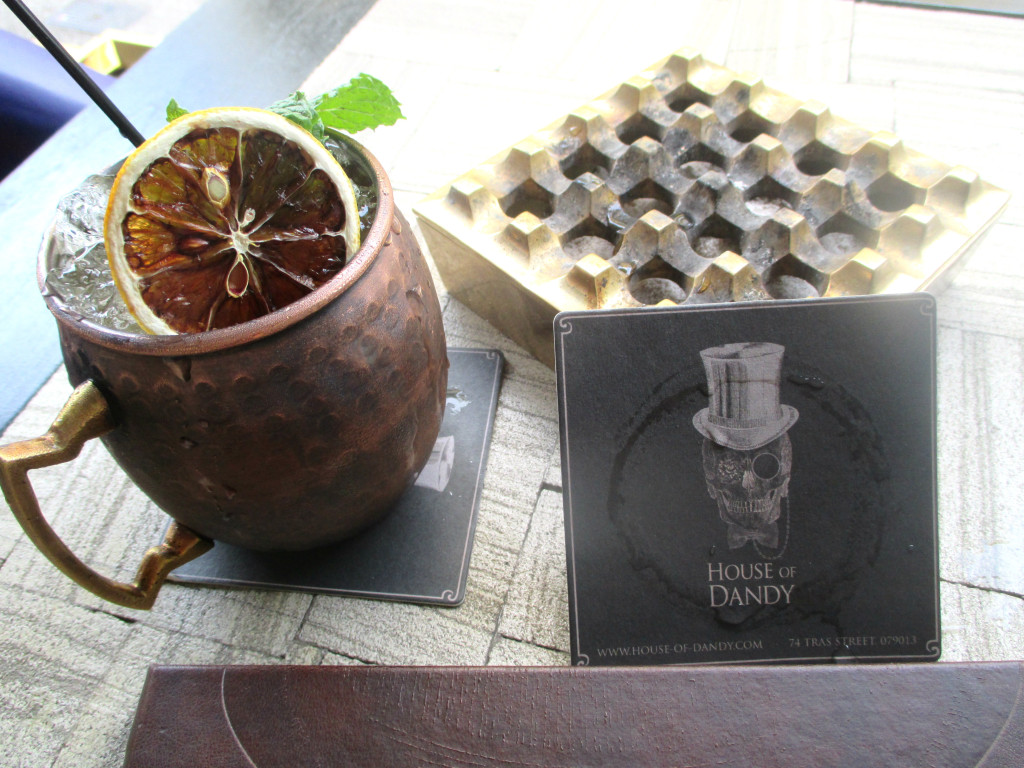
House of Dandy in the Tanjong Pagar area also has a proclivity for the irreverent. Despite being a temple to the dandy (a middle-class man in the 1800s who highly valued his refined appearance, aristocratic mind, and leisurely hobbies), the upscale cocktail bar hasn’t limited itself to top hats and aristocratic superiority. As their menu explains: “A dandified life is one that is refined and tastefully in excess. Keeping an edge without sacrificing neither style nor standards.” Thus, among the myriad of hedonistic idols that the lounge pays tribute to are Beau Brummell, Oscar Wilde, and Andy Warhol—see the Dandy Warhol cocktail, an inimitable and delicious blend of vodka, Midori, Limoncello, lemon juice, sugar syrup, and egg whites.

While the Miss Wong Cocktail Bar in Siem Reap seeks to emulate 1930s Shanghai, both The Spiffy Dapper and House of Dandy allow themselves to follow the spirit of an exalted era through the years. The bathroom at The Spiffy Dapper is a maddening tribute to Stanley Kubrick’s film A Clockwork Orange and the walls at House of Dandy feature portraits of women wearing revealing outfits and Stormtrooper helmets. Singapore isn’t searching for a flawless recreation of a past decade, but rather for a taste of the irreverence that was once possible. The speakeasies of today strive to provide that old, gossamer spirit of carelessness in a world where now every foolish act can be splattered across the internet in seconds. So if you find yourself nostalgic for a time when leisure was uninterrupted by mobile phones and secrets remained secrets, slip into the dim interior of a speakeasy. Bring high expectations for a quality cocktail. Remember to sip slowly.

Where to Find:

Miss Wong Cocktail Bar
The Lane, Siem Reap
Cambodia

The Spiffy Dapper
2/F 61 Boat Quay
Singapore

House of Dandy
74 Tras Street
Singapore

Singapore American logo


World Art on a Historic Street

Published on April 1, 2014 in the Singapore American Newspaper:

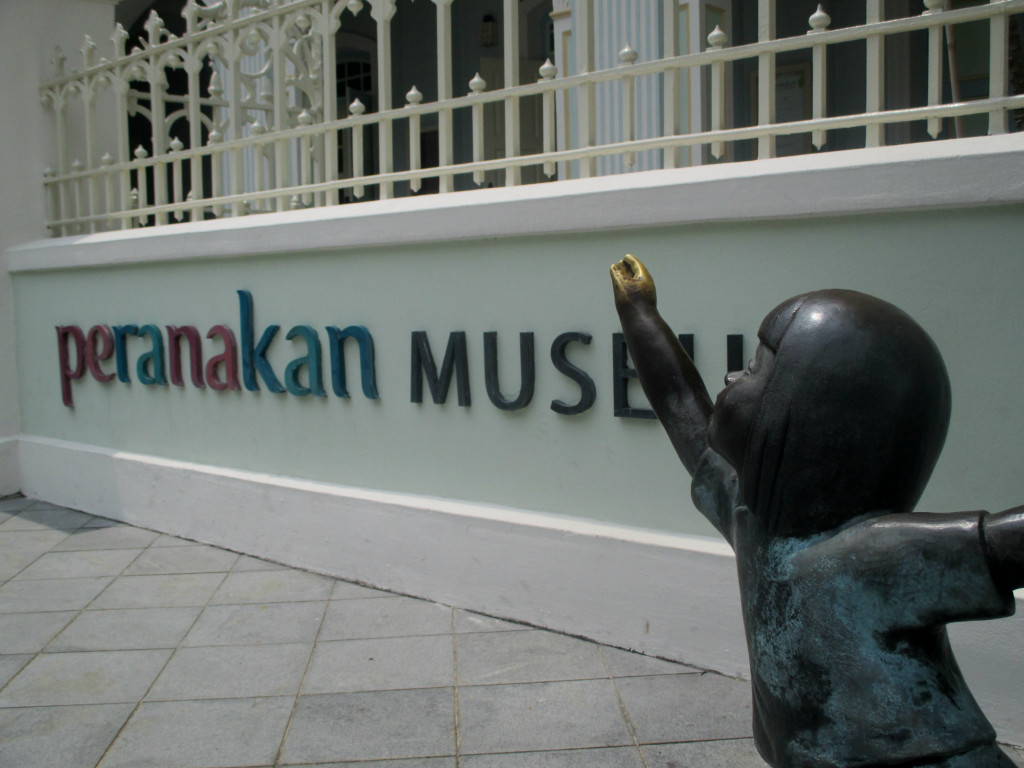
Peranakan Museum

Beginning at Coleman Street and ending a short distance away at the junction of Stamford Road and Waterloo Street, Armenian Street is just a squib of a lane in the city’s civic district. But don’t let its modest length fool you; for anyone looking for a delectable dose of art in all its forms, Armenian Street is a place not to be missed. Nestled in the rows of refurbished art deco shophouses from the 1930s to 1950s are historic paintings, modern sculptures, dramatic performances, film screenings and sophisticated architecture.

If you’re intrigued by the patterns and shapes of Singapore’s history, the Peranakan Museum is home to a rich collection of porcelain Nonyaware pieces in every color, intricate beadwork purses, gilded teakwood cabinets and armchairs, protective amulets with bells and tiger claws, an elaborate wedding portmanteau, and even a selection of old telephones that connect you to conversations from another era. The museum is housed in the Old Tao Nan School building, an elegant relic from 1910 that features arched verandahs, high ceilings and sweeping symmetrical staircases fashionable in Europe at the time. The cool rooms and quiet galleries are a serene space to peruse on a hot afternoon.

If vibrant, live performances are more your style, I suggest you hit The Substation. As its name suggests, the building was previously a power sub-station until 1990, when it was transformed into the nation’s first independent modern arts centre by playwright and director Kuo Pao Kun, who is considered the pioneer of Singapore theatre. Today, The Substation continues to be known as an incubator for emerging or experimenting artists, who fill the black box theatre, gallery, dance studio, classrooms, and garden with everything from short films to one-act plays to multi-ethnic love letters.

For those craving a secluded moment with contemporary artwork, both 11.12 Gallery and Mulan Gallery feature unique pieces by an array of artists. However, it is the grand four-story Art Plural Gallery that stands capacious and proud as one of the focal points of not only Armenian Street, but of the Singapore art community. Back in 2008, Carole and Frédéric de Senarclens predicted that Singapore was poised to become a hub for the Asian art world and since opening Art Plural Gallery with a splash in 2011, they have only been proven right. The couple wanted to be in the historical and cultural district, so it only made sense that Armenian Street would become their carefully chosen base on the island. In the midst of Singapore’s heritage and museums, Art Plural Gallery nevertheless mimics the country’s pivot towards the international and Frédéric travels the globe to find promising artists to feature.

Recently, the gallery collaborated with Audemars Piguet and Gatehouse Publishing to launch a book that explores and celebrates the growing presence of globalization in contemporary art. Art historian and author Michael Peppiatt declares in the book’s introduction: “The artists of today are constantly on the move…This conjunction has given rise to a diversity hitherto unknown in any medium at any previous moment in the world. And the key word here is world because, for all the indications that national or local traditions remain influential, there can be no doubt that we have reached a moment when we can talk convincingly in terms of world art.”

Few countries could compete with Singapore as a crossroads and flagship for artists who not only reflect strains of globalization in their work but who have also themselves gained international recognition. When I suggested that galleries such as Art Plural were integral to this island’s burgeoning reputation as a multi-ethnic art center, Carole insisted: “We’re just part of the momentum. We couldn’t exist without the museums, without even the Peranakan Museum, around us in this neighborhood. It all combines together to make a really interesting artistic hub.”

“Armenian Street is at the center of the future arts district,” Frédéric added confidently. “I think it’s one of the best locations in Singapore.”

Singapore American logo


Why I Thought of You at the Duchess County Fair

Published on March 1, 2014 in the Singapore American Newspaper:

poem

Pregnant with screaming bodies,
the rides lurched overhead
like drunk Christmas trees.
But before the night took us there,
the cows, quieted by evening,
slept or shuffled on either side
of the barn’s opened belly.
Their prize ribbons swung above,
a dribbling rainbow nailed up
by its strings and pride.
I didn’t look up,
distracted by the tongue braceleting my wrist
and sanding down my knuckles,
the press of the calf’s nose into the cup of my palm.

For Dad’s Birthday 2008

Singapore American logo

Internet Safety for the Casual User: Q & A with Nicholas Schwartz

Published on February 1, 2014 in the Singapore American Newspaper:

As expats, how can we not adore the Internet? We can stay in touch with our distant loved ones via an array of seemingly cost-free tools and platforms. The convenience offered by these services is tempting—it’s quicker if your browser saves your passwords, it’s handy to back up files online, it’s useful if social media sites know your home address—but what’s easier for you to access is easier for hackers to get to as well. It can be tough to balance the addictive joys of social media with the dangers that come with sharing your personal information online. I sat down with Nicholas Schwartz, an Information Security Technical Consultant at the Bank of New York Mellon, to get some tips on how to stay safe. Note that these suggestions are primarily for Windows users as viruses are generally not targeted at Apple computers.

SAN: How much personal information is a safe amount to put out there?

NS: It’s better to operate with the mentality that your information is already out there, since many people besides you can disclose data about you. For example, if you list your email address in a corporate presentation and your company uploads it to the Internet, your email is now out there for anyone to find.

SAN: So then how can we keep ourselves safe on sites like Facebook?

NS: On all social media sites, the most important things to watch out for are malicious links. They seem so straightforward but can send you to websites that can infect your machine with malware. This also goes for any links in emails, even those from trusted sources. If a link looks suspicious, take five seconds to right click on the link, select Copy Hyperlink, Copy Shortcut or Copy Link Location, and paste the result into Google. If there are no identical matches or if there is mention of it being related to spam or malware, do not click through.

SAN: For the casual internet user, what would your number one tip be?

NS: Download the Adblock Plus plugin for Firefox, Chrome or Internet Explorer. Even secure websites, such as The New York Times, lease areas of each page to advertising providers, who are in turn responsible for selecting the ads which are displayed. If an advertising provider is compromised, malware can be sent in an advertisement’s place and infect you on an otherwise secure website. By forbidding advertisements, Adblock Plus blocks a significant attack vector.

SAN: Do you have any suggestions specifically for expats?

NS: If you have ever made a scan of your passport or a copy of your signature and emailed it, remember that if anyone gets access to your email, they will be able to get ahold of that as well. So delete the message from your Sent folder. This is pertinent not only to expats but to any frequent travelers. Tempting as it is, it’s a bad idea to retain copies of important documents in any repository that can be accessed from the web (like Google Drive or Dropbox).

SAN: So if my email or social media accounts are hacked, what should I do?

NS: If any of your major accounts have been compromised, the first and most important thing to do is to secure your personal email account by changing the password from a computer other than one you normally use. The worst-case scenario is if someone has direct access to your machine via a Trojan Horse; it doesn’t matter how strong your security measures are if a virus is recording every key you press. If this has happened, you will need to bring your computer to an IT specialist as very few — if any — anti-virus products will detect or remove this type of malware. The hard drive will need to be completely wiped and the operating system reinstalled. It’s exhausting, to be sure, but that type of malware is too grave a danger to do anything short of that.

Singapore American logo


Camping Out in the Outback

Published on February 1, 2014 in the Singapore American Newspaper:

I prepared for our long weekend in Australia with a thorough Googling: first-aid for snake bites, how to recognize which spiders were poisonous and which were just enormous, and what to do if I came face to face with a crocodile (apparently, sprint away). If that seems like a bit much, it was because we weren’t visiting one of Australia’s metropolises but rather, we were going camping in Litchfield National Park.

The flight to Darwin, the capital city of the Northern Territory, was a manageable four hours from Singapore. As October is just the beginning of Australia’s roasting summer, the petite port city was bathed in dry heat and sunshine hot enough to make you squint. It’s a sleepy town that caters to adventurous tourists and features a cheerful, easygoing nightlife. We spent the entirety of our first day there, soaking in the laidback atmosphere and obtaining supplies for our weekend in the wilderness. Dinner that night was along the wharf at a restaurant called il Lido, where we sampled the native fare: kangaroo meat kebabs, freshly caught barramundi and a selection of the local bottled ales. We picked our plates clean.

Darwin is surrounded by an array of national parks, nature reserves, and conservation areas. We decided to spend our two days and two nights of camping in Litchfield National Park as it was only 100 kilometers southwest of Darwin. Including myself and my husband, we were a group of six. The two couples we were traveling with had decided to rent campervans equipped with small gas stoves, squat fridges, and narrow beds. We took a different route, opting instead to rent old-fashioned camping equipment from a local business as well as a small car. Driving along the narrow highway, I wondered what the pros and cons of each camping style would be. Outside my window was a vast tricolor landscape: red earth, spring green trees, and blistering blue skies.

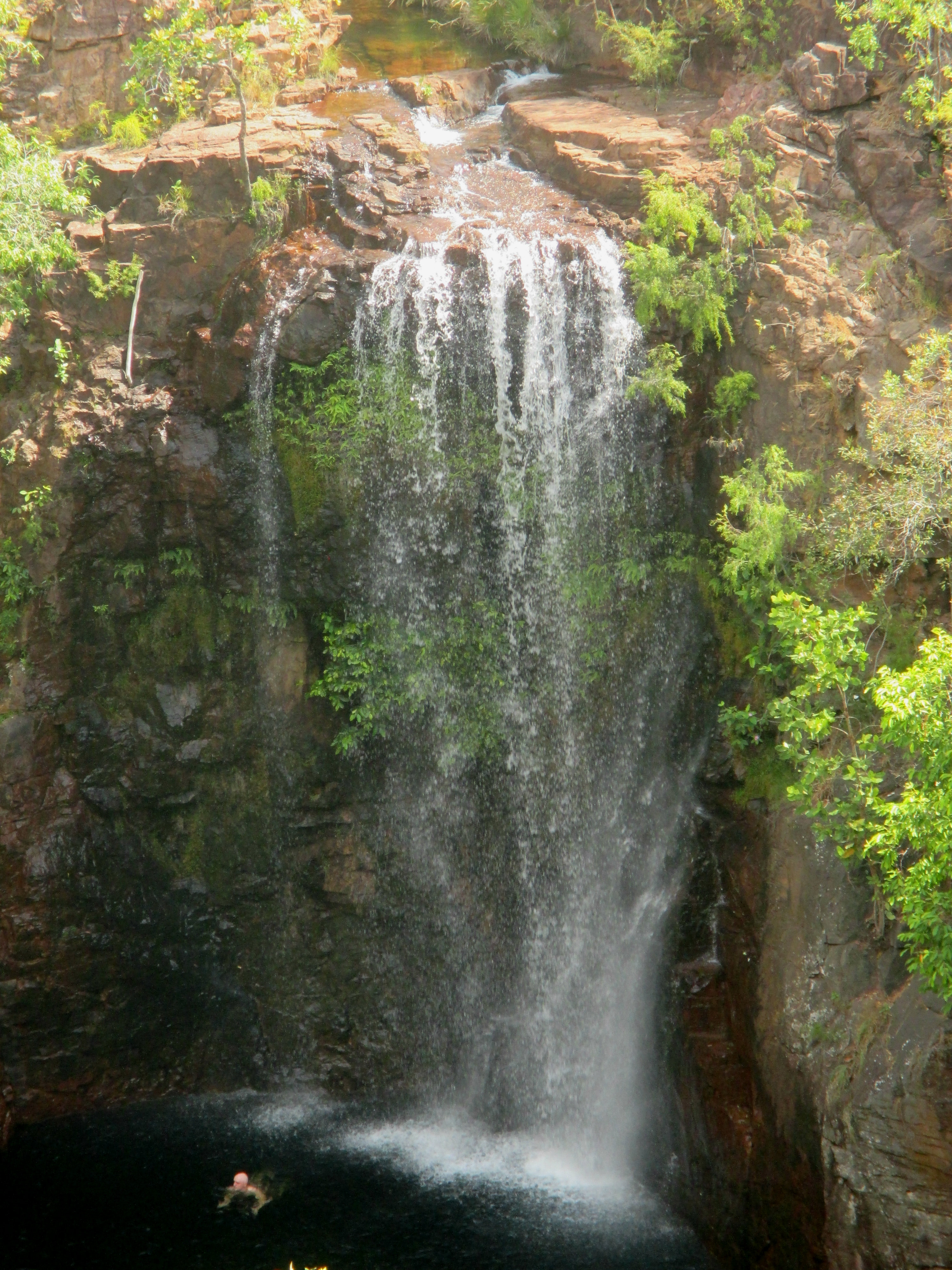
Florence Falls

Our first stop upon reaching the outskirts of the park was at the magnetic termite mounds. Built by thousands of termites, these monoliths stand several meters tall and, amazingly, are oriented north-south for optimal climate control. We then took the shady, creek-side path to Florence Falls, a picturesque waterfall that spills into a plunge pool. After trekking through the high heat of the afternoon, leaping into that crystal clear swimming hole was unspeakably refreshing. Bottles of local beer in hand, we whiled away the day here as well as a short distance away at the Buley Rock Pools, a lazy cascade that links a series of natural shallow pools. Every year Litchfield National Park attracts over 260,000 visitors and though a number of other tourists (both Australian and foreign) were present, these lush sites never felt too crowded.

Campsites could be found throughout the park, each with their own set of rules and amenities. Some allow motor homes while some only allowed campervans or old-fashioned tents. Almost all sites have public bathrooms that offer clean toilets (with toilet paper!), sinks with potable water, and several showers. There is a minimal fee for camping overnight and guests are trusted to deposit their dues in locked boxes posted around the area. The grounds near Wangi Falls provided us with a three-pronged campsite perfect for our group and just as we were pulling in, we met a good omen: a wallaroo. Smaller than a kangaroo but larger than a wallaby, these gregarious creatures could be spied hopping through the brush throughout the whole park.

While the others set up a table and chairs between the campervans, we pitched our two-man tent and unrolled our swags. A nearby picnic area provided a grill for our burgers, sausages, and ears of corn, and dinner was lively. There was a call for s’mores and so we built a small fire on the sandy ground. Lacking graham crackers, Hershey’s chocolate bars, and jumbo American marshmallows, we improvised with what we had been able to find at the Woolworths in Darwin: digestive biscuits, bars of Lindt milk chocolate, and a packet of squat pink and white marshmallows sporting a thin coat of sugar. Not quite the s’mores I had growing up, but not bad.

Chopper's Den

The night was broiling and sleep was an erratic, sweaty affair. While our tent had netted windows that allowed a breeze in, the campervans were stifling. However, they were mighty helpful at breakfast. Their fridges and kitchenware were invaluable; a cooler couldn’t have kept our meat and milk from spoiling in the outback’s brutal heat and I don’t know where we would have rented pans and spatulas during our short stay.

We set off for the majestic Wangi Falls at midmorning but were prevented from our much-desired swim due to a recent crocodile sighting and so trekked to the Tolmer Falls lookout instead. It was a hot, dry hike through the bush. Sandstone and quartzite had formed blocky, colorful shapes and sharp cliff faces. Far below the viewing platform were pools as bright and clear as green glass. After a quick lunch of sandwiches, we embarked on the trail to the Cascades waterfalls, a hike with more challenging and varied terrain: dense rainforest, leech-populated streams, layers of red rock, and desert plains.

Our choice of campsite for that night, the Florence Falls area, didn’t have any barbecues but the campervans’ stovetop cookers worked in a pinch for dinner and also for the following morning’s breakfast. Not long after washing up, my husband and I bundled our gear and bid our friends goodbye. We would meet them at the airport later; there was one more thing I wanted to do in Darwin before we left.

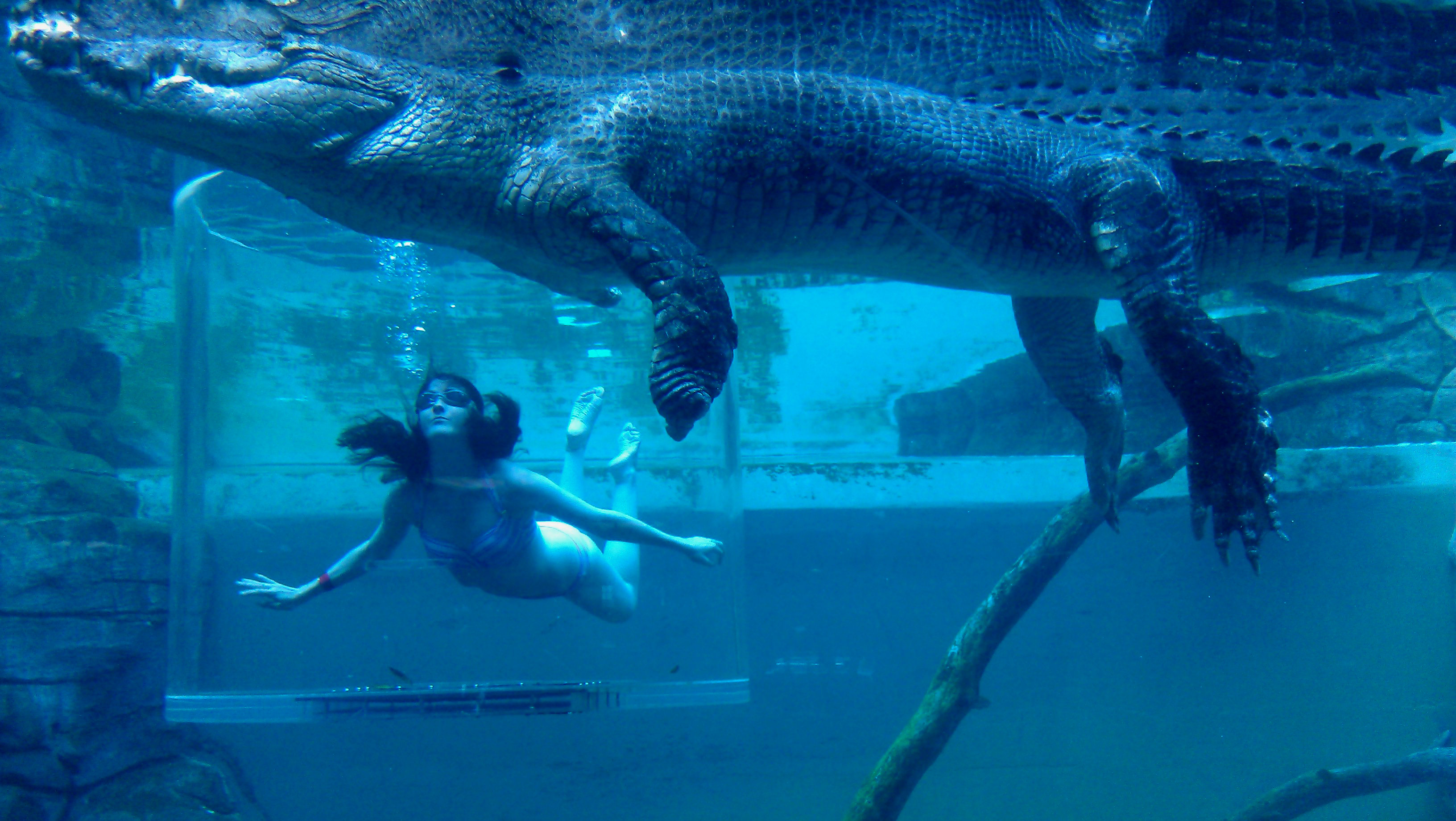
Nestled in the center of the city, Crocosaurus Cove is home to a number of prehistorically large crocodiles, including Burt, the star of Crocodile Dundee, and I intended to swim with one. Clad in my bikini and a pair of goggles, I climbed into a mesh and plexiglass cylinder (comfortingly named the Cage of Death) and was lowered into the den of Chopper, who was over 80 years old and missing his two front claws thanks to battles with other crocodiles in the wild. Despite the thick barrier, it was impossible not to feel awed, small and extremely edible next to Chopper’s monstrous, lithe form. My pre-Australia Internet research had instructed me to fight back should I find myself caught in a crocodile’s jaws, but as I swam alongside several tons of muscled reptile, the very thought of struggling seemed ludicrous. It just goes to show that there is only so much the Internet can teach you about the world; at some point you’ve got to get out there and tackle it yourself.

Singapore American logo


Top Eight Places to “Work from Home”

Published on December 1, 2013 in the Singapore American Newspaper:

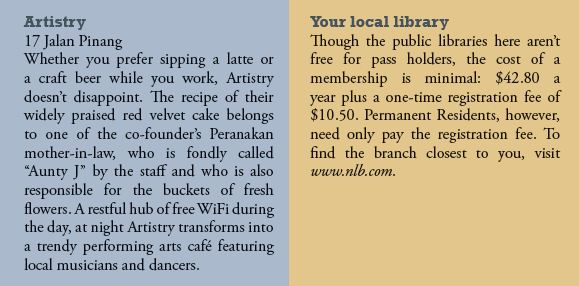
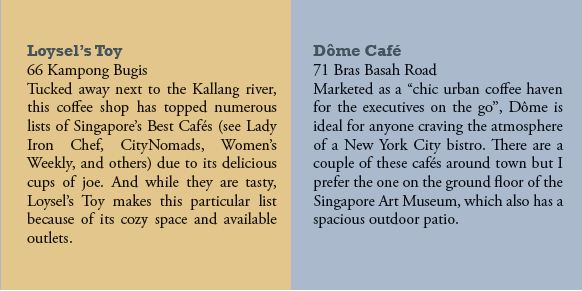
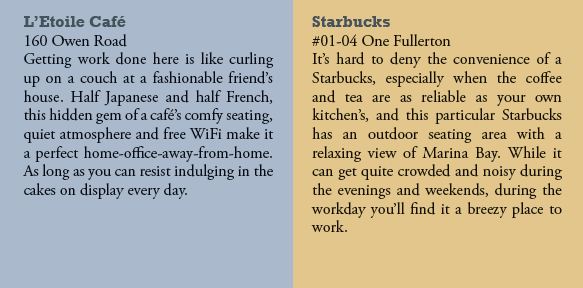
In this modern day and age, “working from home” can mean working from almost anywhere if you play your cards right. Plus, a change of scenery can do wonders for your creativity and motivation, whether it’s writing an article, putting together a lesson plan or organizing leads on Salesforce. When I get bored of my apartment’s four walls, here are my top eight places to work from home (in no particular order):

7-8

3-4

5-6

1-2

As a final note, I want to say that while there are reliable hubs of strong WiFi to be found throughout the city, it is far more convenient to transform your smartphone into a WiFi Hotspot. Not only is it safer than connecting your laptop to a public network, a Hotspot relies on Singapore’s ubiquitous 3G signal (meaning it can be employed just about anywhere). There are plenty of YouTube videos and how-to guides on the internet to walk you through setting a Hotspot up and, trust me, you will be thrilled you did. Now get back to work.

Singapore American logo


The Nature of Sri Lanka

Published on November 1, 2013 in the Singapore American Newspaper:

How would you describe your ideal travel destination? Tropical beaches or crisp mountains? Adventurous hikes or luxe spas? Exquisite food or cultural wonders? Even if you chose all of the above, Sri Lanka fits the bill. As it were, my friends and I decided to make nature and wildlife the primary focus of our ten-day trip around the island nation. We were not disappointed.

Sri Lanka has excellent roads and for a multi-city tour like ours, a driver was by far the best option for getting around. Our trip began at dawn in Negombo, a coastal city seven kilometers north of Colombo, where we observed the bustling outdoor fish market in action. Brightly painted fishing boats filled the green waters of the Laccadive Sea and the docks were busy with butchers expertly lopping the heads off fish larger than me. Along the 100 km long canal, groups of men and women could be spotted shaking nets to loosen tiny fish, which danced and glittered under the watchful eyes of cats and crows. When I smiled at people, they smiled back.

We drove from Kalpitiya (on the west coast and perfect for dolphin watching) inland to Sigiriya, and it was impossible to resist pulling over to sample the myriad of freshly picked local fruit. Bright hanging bunches of apples. Small, fragrant bananas. Piles of fresh pineapples, durians, and jackfruit. If you’ve never tasted a rambutan, mangosteen, or king coconut, this is the place to do it. Painted Buddhas, white stupas, and pastel-colored churches flew by our windows, but our attention was seized by the mammoth Lion Rock in the distance. 200 meters high and shot through with red and white layers of stone, the boulder can be seen for miles. Visitors climb to the summit via narrow staircases, passing by acrobatic families of monkeys, colorful frescoes, and the Mirror Wall, which once upon a time was so well polished that the king could see himself as he walked alongside it. A sudden squall hit when we were two-thirds into our ascent, but we pressed on and up through the whipping winds and pouring rain, and we were rewarded shortly after reaching the grassy top. The storm dissipated and the fog rolled back to reveal an endless, deep green landscape stretching out around us in all directions.

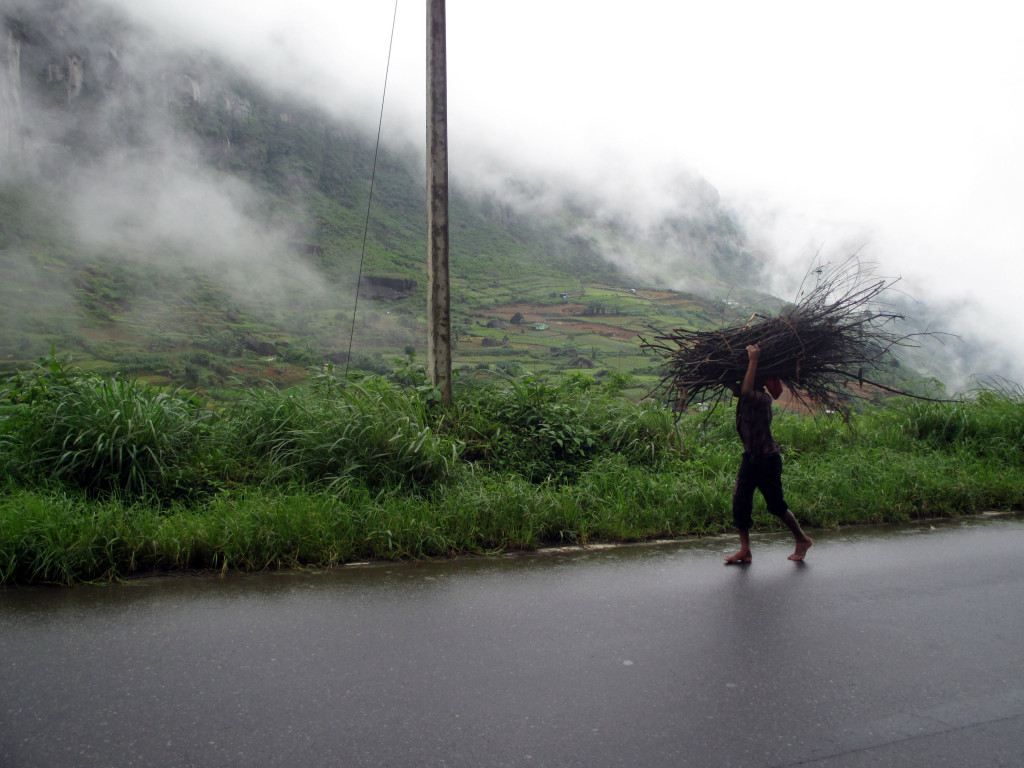
We spared a few hours for Kandy, a lively little city that encapsulated Sri Lanka’s easy blend of modernity and heritage. Men and women wore both western and traditional clothing. Post offices, police stations, medical centers, banks, and the public bus system all appeared readily available across the country. Yet there was a refreshing lack of a dominant fast food presence. For the next leg of our journey, our van climbed out of the tropical jungles up to the misty tea plantations nestled near the cool summits of Nuwara Eliya’s mountain ranges. Tamil women moved through the winding rows of Assam bushes with practiced ease, plucking the young leaves and shoving handfuls into the sacks on their backs. Though there are a number of smaller inns and lodges balanced on the mountainsides, I suggest splurging on a stay at the Heritance Tea Factory, which has been refurbished into an elegant hotel that retains almost all of the factory’s original 1930s infrastructure.

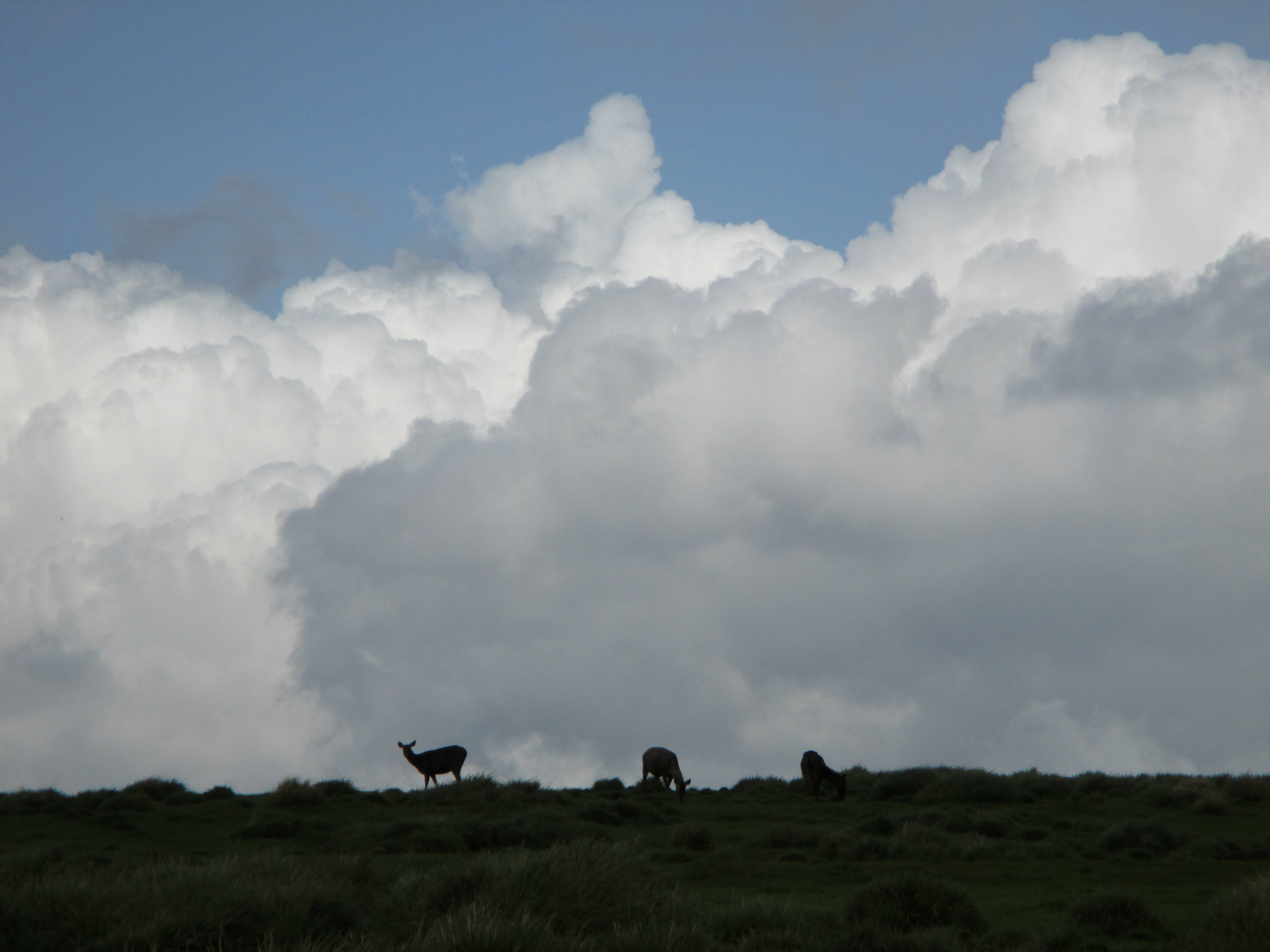
The next morning was crisp and sunny. Though I didn’t think it was possible, our little van climbed even higher, up into and above the clouds, where we tackled the nine km World’s End hike across the Horton Plains. We marveled at the herds of elk in the vast grasslands and the proximity of the clouds to the dense forests. The trail led to a vantage point perched on a sheer cliff drop overlooking a rolling basin ringed by mountains that lurched into the sky.

Horton Plains (1)

Although we had retained our driver, Upali, for the entirety of the trip, we couldn’t resist taking a train back down from tea country. Though not the fastest form of transportation in the country, it is without a doubt the most scenic. Our blue locomotive raced through corridors of lush foliage that would suddenly give way to views of immense valleys dotted with terraced farms and varicolored villages, surrounded by infinite waves of highlands. Sri Lanka is a rainbow of greens: emerald Assam tea bushes, pale new sprouts in vegetable patches, dark and gargantuan forests that run rampant up steep mountainsides.

In the southeastern town of Tissamaharama that night, we went to sleep early so as to rise before dawn the following morning for an all-day safari in Yala National Park. It was a long, dusty, adrenaline-fueled day spent in an open-air jeep hunting for a glimpse of a wild leopard. We were lucky enough to find one napping in the crook of a tree while locked in a hilariously quiet traffic jam of jeeps all trying to get close without disturbing the creature. For me however, the real treat was witnessing a family of elephants (including two infants) splash in the mud of a reservoir in the hot afternoon. There were a number of other animal sightings and we didn’t leave the park until after sunset.

Our next destination was the southern city of Galle, a historic colonial town cradled inside the barricades of a Dutch fort. Engulfed in such picturesque scenery, it’s easy to be lulled by the waving palms and clean beaches, but the memory of the devastating 2004 tsunami lingers. Just off the coast, portions of the old road could be seen in the sparkling surf. Memorials could be found in every town and park we’d visited. Cemeteries were full of tombstones constructed from debris. Chunks of wrecked houses stood along the shore, now veiled by creeping vines. These somber markers were a reminder that behind this natural paradise was a grim and difficult past.

For our final day we again awoke at sunrise, this time to travel by tuk tuk to the harbor in Mirissa to set sail with Raja and the Whales, a tour company I found professional, knowledgeable, and friendly. They located a trio of blue whales and brought us in close without disrespecting the giant creatures’ space. Before heading to the airport we popped by the Kosgoda Turtle Hatchery, which was obliterated in 2004 and rebuilt thanks to donations. After sunset, we brought precious three-day-old turtles to the seashore and watched them scamper from our hands towards the pounding surf that called them home.

Alongside its layered history and colorful culture, Sri Lanka nurtures a rich and varied natural world: feisty fruit and serene landscapes, safaris in prairies and at sea, cool peaks and steamy beaches. We easily could have spent a week in every place we visited. I’m already planning my second trip.

Singapore American logo


Alternative Expat Hotspots

Published on October 1, 2013 in the Singapore American Newspaper:

For a Friday or Saturday night out, the lure of Singapore’s expat hubs is hard to deny. The glitter of the clubs and the ambience of the pubs, the platters of bar food and the heavy steins of beer, the loud music and the reflection of the lights on the river’s surface… Unfortunately, it is equally hard to deny the dent these hubs can make in your wallet. Luckily this city has a seemingly endless amount of hidden gastronomic gems just waiting for you to explore. Whether you are looking to impress your visitors with your local know-how or are just in the mood for a less-touristy but still centrally located spot for dinner, the following suggestions are sure to make for a great night out.

Instead of Boat Quay…

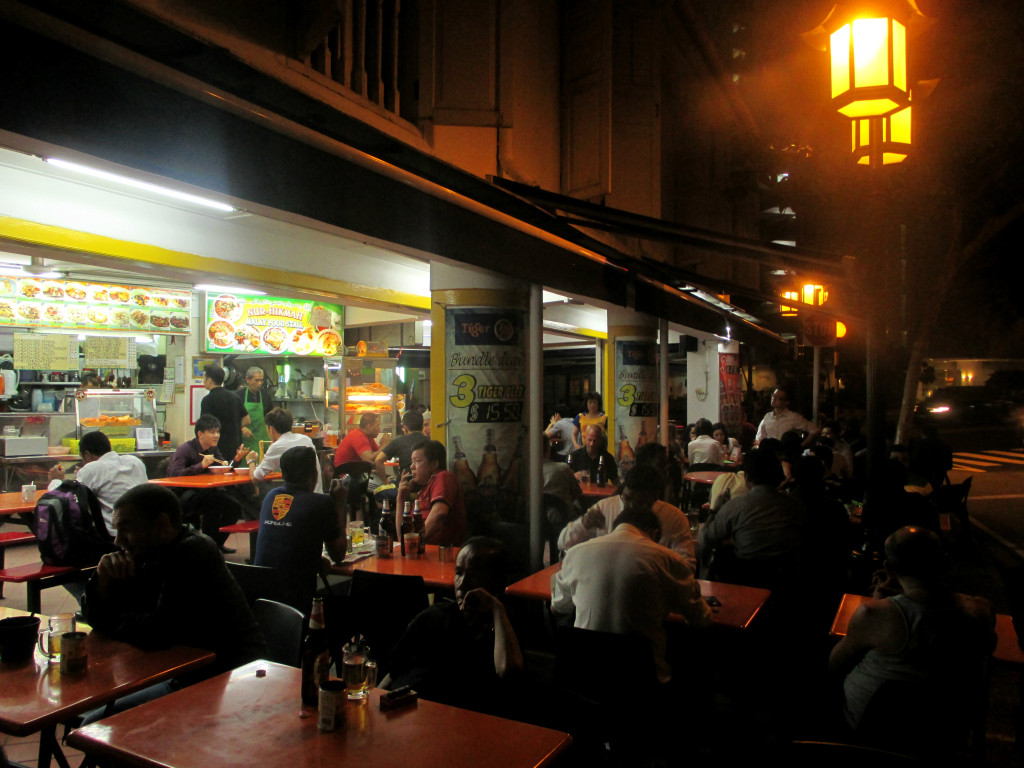
When my in-laws visited a year ago, my husband took them along the glitzy strip of Boat Quay and then through the back to an open-air hawker center called BK Eating House, which sits behind the bars at 21 South Bridge Road. Though the plastic tables and fluorescent lighting didn’t impress my in-laws much, the specialty dry mee sua from the Yan Kee stall sure did. Not only do they claim to this day that it was the best meal they had during their time in Singapore, at $3.50 a bowl it was also the cheapest. And since the cost of one beer at a bar on the river will get you three beers at BK Eating House, it’s easy to forgive its artless appearance.

BK Eating House

Instead of Chijmes…

Instead of paying for expensive cocktails within the walls of Chijmes, stroll two blocks over to Standing Sushi Bar at 8 Queen Street. There are a plethora of good Japanese restaurants but I have yet to find one that rivals this lively restaurant. A stone’s throw from the Singapore Art Museum, Standing Sushi offers exceptionally fresh sashimi as well as an enormous selection of sake. Every weeknight features a different promotion (50% off sushi, sashimi, and alcohol, anyone?) but the prices are reasonable even without them. However, you will want to get there either before or after the peak dinner time as the restaurant doesn’t take reservations and the line outside can get pretty long.

Instead of Clarke Quay…

Across the river from the theme park-esque Clarke Quay, the Central Mall houses a barely marked bistro you won’t want to miss. You may have heard of No Signboard, dubbed as such because when it was a single stand in a hawker center in the 1970s, the founders simply couldn’t afford a signboard. Back then seafood wasn’t commonly sold in hawker centers but their unique crab recipes attracted much attention and today No Signboard has six branches, one of which is hidden in a corner on the fourth floor of the Central. A far cry from the original stall, this particular outlet is elegantly decorated and sports large windows that look out at Clarke Quay over the river. While you’ll have to try the famous chili crab or white pepper crab (which you buy by the kilogram), I also highly recommend the sliced mushrooms with abalone sauce over rice.

Instead of Robertson Quay…

For inexpensive wine and tasty food, it is hard to beat Wine Connection at Robertson Quay but if you’re looking for a real contender, check out the triple threat of The Foundry, Baan Khun Nai, and The Burger Office. All can be found sharing the same space at 18 Mohamed Sultan Road, the atmosphere of which can only be described as beach-like, eclectic, and relaxed. The Foundry prides itself on its choice selection of Belgian craft beers (I suggest a pint of the Kronenbourg 1664 Blanc). Baan Khun Nai serves up classic and succulent Thai food. And The Burger Office, as expected, specializes in straightforwardly delicious beef burgers. Mix and match as you please!

It’s easy for smaller restaurants to get overshadowed by the bright lights of the Quays but these homegrown alternatives make for a more authentic (and generally less costly) meal than what the tourist hubs tend to offer. However, they are also close enough to the parties that you can wander over after you’ve eaten, if you’re still in the mood.

Singapore American logo


Division and Illusions in North Korea, the World’s Most Inexplicable Nation

Published on September 3, 2013 in Young & Global Magazine:

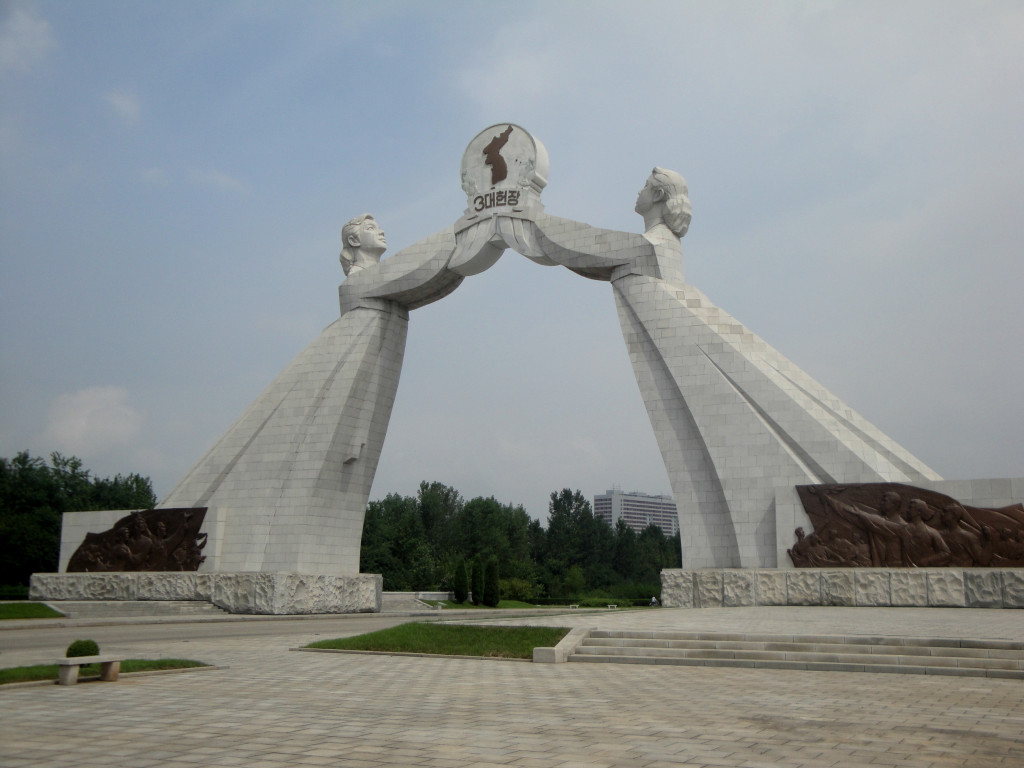
Arch of Reunification

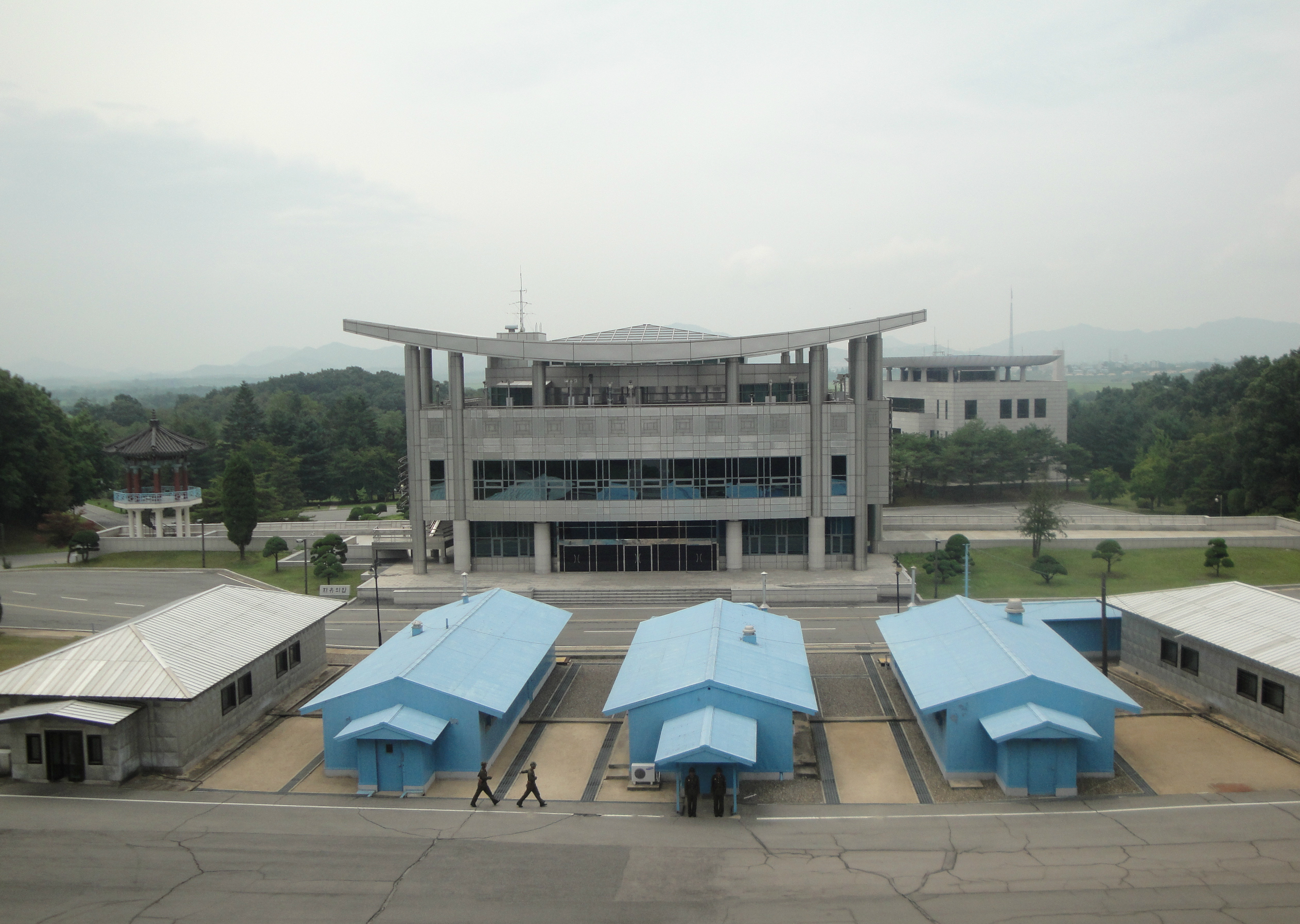
On an overcast afternoon in August, I stood on the upper balcony of Panmungak, the main North Korean building in the Joint Security Area (JSA) of the Korean Demilitarized Zone (DMZ), gazing over narrow, blue buildings. Dead center between Panmungak and the South Korean building called the Freedom House Pagoda, I could see the thick line of concrete that splits the two Koreas. Though we were a mere 70 kilometers from Seoul, it felt like we were on another planet.

Miss Choi, our tour guide, appeared at my elbow. She was a curvy North Korean woman in her thirties, but beyond that I won’t describe her or provide her real name lest I unwittingly get her into trouble. With a placid smile on her face, she led our group down the stairs, out of Panmungak, and across the quiet compound to the squat cyan buildings.

The JSA is used by the two Koreas for diplomatic engagements, but on that day it was devoid of life, save for stiff soldiers and nonchalant sparrows. Since visitors are forbidden from interacting with tourists from the other side, the area operates on something of a timeshare. As we explored the sparse negotiation space that sat squarely on the demarcation line, Miss Choi recited historic moments and explained that the main obstacle to the reunification of the Korean peninsula was the posting of American troops at the DMZ.

“Our country is divided. But maybe one day soon you can have breakfast in Pyongyang, lunch in Kaesong, and dinner in Seoul,” she finished wistfully.

The members of our tour group glanced at each other, but no one moved to put forth a conflicting opinion. Two days earlier, in the Beijing airport, a representative from Koryo Tours had warned us to expect such discrepancies. North Koreans have a genuine pride in their country, he had explained, and though they know Westerners have different versions of their country’s history, they simply believe we’re lying. Or ignorant. After all, why would our version of history be truer than what they’ve been told their whole lives? Would you believe a North Korean who told you Abraham Lincoln was a Nazi?

It was in Beijing—one of only four airports in the world that can fly you to North Korea—where I had first met the small group of adventurous travelers who would be my companions on this trip. I knew nothing about these people except that they were expats working in Singapore, and their curiosity about North Korea matched my own. It must, because we would be among only 3,000 or 4,000 non-Chinese tourists to visit the reclusive nation that year. For me, although I had moved to Singapore a mere five days earlier to reunite with my fiancé after a six-month separation, I was curious enough to take this trip he had planned, even if wasn’t quite the romantic reunion vacation I was expecting.

The representative from Koryo Tours had also given us guidelines for our visit. We were not allowed to photograph construction sites or people, and we were forbidden from wandering away from our guide. While it wasn’t impossible to sneak photos or creep off to out-of-bounds areas, Miss Choi had the power to restrict the planned activities for our trip if she judged our group to be unruly. Most importantly, later she would be the one to pay for any and all of our misbehavior. So we mindfully asked whether pictures were permitted and followed her like quiet schoolchildren.

View of Freedom House Pagoda and Joint Security Area from North Korean side

Freedom House Pagoda and Joint Security Area viewed from the DPRK side of the DMZ

A short drive from the DMZ, a military lookout point stood at the peak of a hill, which our secondhand tour bus struggled to climb. Inside the little building, a North Korean colonel in full uniform gave us a history lesson in front of a large painted map. He then gestured for us to follow him outside, where a row of telescopes allowed us to peer out at the peaceful, grassy landscape, riddled with silent landmines. Beyond a tiny wall marking the border, military bases flew South Korea’s flag. I only half-listened to the colonel’s stilted English; I was skeptical of the veracity of his facts and more interested in studying his appearance. With his large cap and swamp green military garb, he resembled a Chinese officer from the 1960s. I noticed that his bars of honor were actually a multicolored square of plastic, and I wondered if he had seen a picture of a decorated official and endeavored to appear equally important. Affixed directly above this facsimile was a red, flag-shaped pin that featured Kim Il Sung’s smiling face.

Every adult I had seen in North Korea sported this red pin on his or her left breast, sometimes accompanied by a second red pin featuring the image of Kim Jong-il. Miss Choi said the pins were worn simply out of a desire to show respect; there was no mention of compulsion. However, I later learned that the law used to be: forget to wear your pin once, receive a warning; forget it a second time and face punishment.

Much like the colonel’s illusion of military honor, I discovered that the nearby city of Kaesong was also designed to appear more than it was. Houses of solid concrete had brick patterns painted on their exteriors, and concrete walls sported motifs to mimic stone ones. Kaesong was the only city to change control from South to North Korea because of the Korean War. As such, it is the southernmost city in North Korea. Its name translates to “Triumph”, but it is a town of worn buildings and of families fractured by the 38th Parallel.

Atop a hill, a towering bronze figure of Kim Il Sung gazed down a steep road into the little city. Despite the fact that we arrived into Kaesong at 5:30pm and rush hour was in full swing, the streets were scantily populated. As we would for all dinners on the trip, we ate in a nice restaurant filled with only Western tourists, and it soon became apparent that the locals didn’t make a habit of eating out. We slept in a traditional inn, sleeping under mosquito nets in the heavy darkness of North Korea’s nightly nationwide blackout.

The following day, the drive from Kaesong to the capital of Pyongyang took two hours on Reunification Highway, which had no lane lines, but was peppered with guarded checkpoints. Except for the occasional truck or other tour bus, the highway was empty. Tunnels were devoid of lighting. Cornfields lined the road, as well as flat plains in all shades of green and brown merging into distant mountains. We passed tanned men and women on bicycles, brown cows tied up to graze, children bathing in shallow rivers. It’s easy to forget in such a strange country –especially one so ideologically at odds with the Western world – that people are just people everywhere.

A plush pink charm of the whole Korean peninsula swung from the bus’s rearview mirror as Miss Choi gave us lessons on her country’s history and culture. Once again I was struck not only by the bizarre interpretations of historical events but how much weight they still carried in the present. It seemed to me that the people of North Korea obsessively clung to past slights and lorded over past triumphs, while the rest of the world had long since moved on.

The history North Koreans tell is an idealistic, childlike version of the world. Their heroes are brave, their leaders compassionate and wise, their enemies evil and uncomplicated. The big questions have been answered unambiguously. But looking out over the serene landscape I wondered about the people starving somewhere hidden from view. Did they still love their country, their Eternal President, their Great General? Or was the illusion shattered? Were they heartbroken?

Before arriving in Pyongyang, we pulled over to admire the Arch of Reunification, which straddled the highway itself. The concrete monument consisted of two women in traditional Korean dress—one representing the North and the other the South—leaning forward to jointly uphold a sphere emblazoned with the complete land of Korea.

Looking at the Arch, I didn’t know where the future would take this inexplicable nation, but I knew it wouldn’t be to the joyous and peaceful reunification the North Koreans were convinced was imminent. I also knew that anything I said to the contrary would at best fall on deaf ears, and at worst endanger the safety of our sweet-natured tour guide, so I simply took a photograph of the monument before we moved on.

Young & Global Magazine


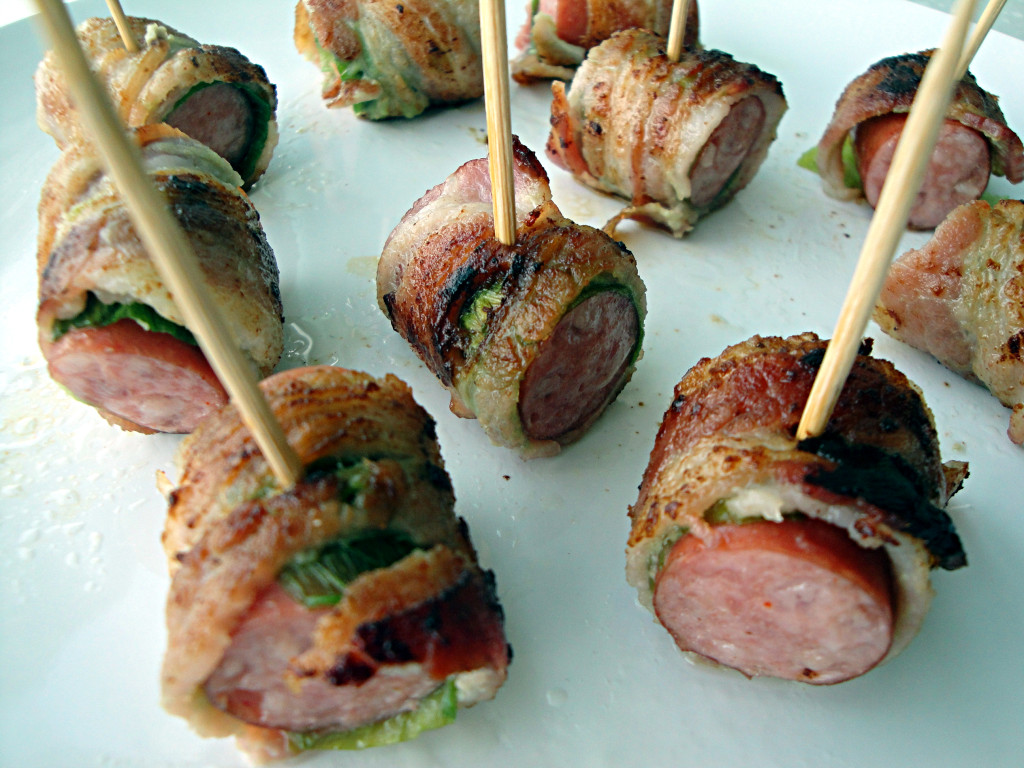
“The Thousand Autumns of Jacob de Zoet” & Wasabi Cocktail Sausages

Recently posted over at PAPER/PLATES is my article about The Thousand Autumns of Jacob de Zoet, the latest novel from David Mitchell (author of Cloud Atlas), and the fusion party food recipe it reminded me of. PAPER/PLATES is run by my friend Amina Elahi and it features book reviews, delicious recipes, and (the best part) recipes inspired by books.

Here’s a snippet of my post:

Mitchell seamlessly alternates between the protagonists’ starkly different perspectives: Jacob’s pious, well-meaning but often clumsy standpoint; Ogawa’s careful balance of personal desires and societal demands; and Orito’s feminine strength and fierce will to survive. The author paints rich pictures of both Dutch and Japanese interpretations of the state of the world in the 18th century, which means one thing: fusion recipe. And since Mitchell doesn’t skimp on the tiny details, I thought something that required a bit of finesse was in order. Dejima was built to constrain foreign traders as part of Japan’s self-imposed isolationist policy, and this recipe delightfully mimics that concept by constraining European sausages in Asian ingredients: wasabi and spring onion.

You can read the rest of the article and find the Wasabi Cocktail Sausages recipe HERE.

And make sure to check out the rest of the blog while you’re at it!

PAPER/PLATES

Top Five Travel Tips for Exploring Asia

Published on August 1, 2013 in the Singapore American Newspaper:

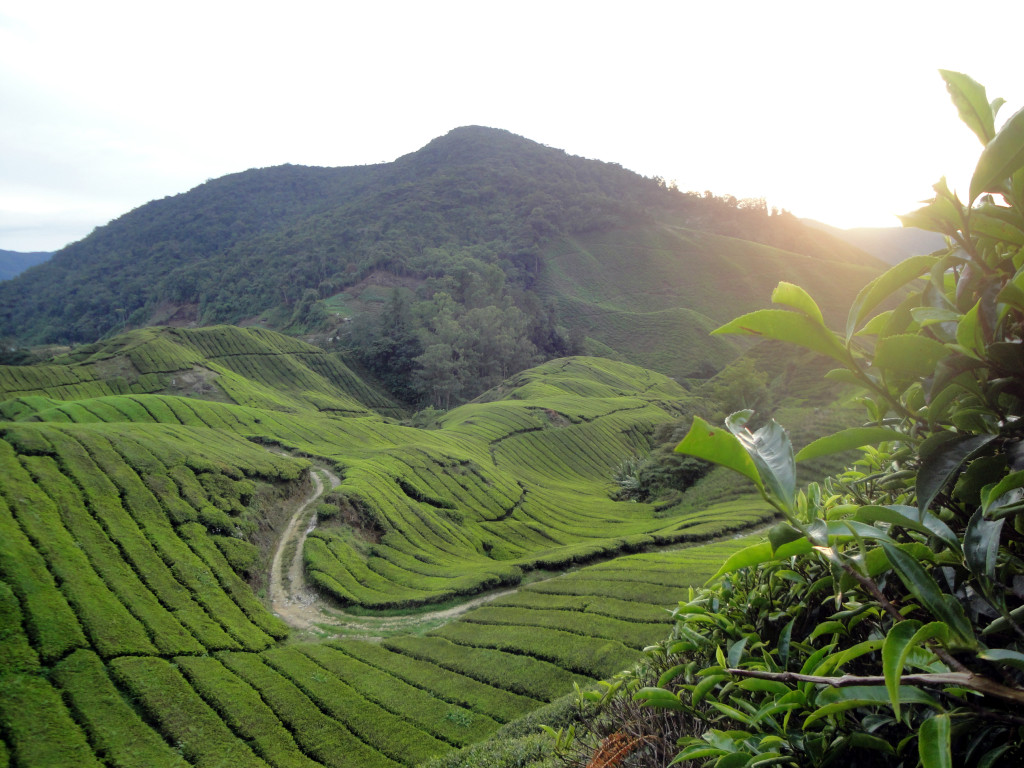
Cameron Highlands, Malaysia

There are plenty of reasons why Singapore is a great place to live. One of them is how easy it is to leave for a short break. Changi Airport has consistently topped lists of the world’s best airports for the last two decades and those with residency status move through it very quickly, but there are still a number of obstacles that can trip you up when setting off to explore Southeast Asia. To help you avoid my mistakes and oversights, here are my top five tips for newcomers to Singapore who are looking to discover the riches of the continent around us.

Number One: Visas!

Visa costs and requirements vary greatly throughout Asia, so right after (or even before) you buy your flight tickets, hit the website of your destination’s embassy to figure out what you’ll need. Many nations surrounding Singapore will allow you to buy an On-Arrival Tourist Visa but some require a Letter of Approval from the local embassy to do this and most can only be purchased in American dollars (and sometimes only in new bills). There can also be extra requirements, like a minimum number of blank passport pages. Bottom line: do your research in advance and prevent a debacle at the airport.

Number Two: Know the Health Risks

Malaria is a year-round risk throughout Southeast Asia but it needn’t prevent you from going where you want to go. A general physician in Singapore can usually provide anti-malarial tablets but be aware that you have to start the regimen a few days before your trip, so give yourself enough time. However, the most frequently reported illness among visitors to Southeast Asia is the highly unglamorous traveler’s diarrhea. While abroad, one of my greatest joys is trying dishes in restaurants frequented by the locals but this can admittedly be risky. So, there are a few rules of thumb to keep in mind when it comes to chowing down. Don’t drink or brush your teeth with the local water. Be sure to check that the seals of any bottles of water you buy are unbroken. Don’t eat raw fruits or vegetables as they have likely been washed in the local water; the exception is fruit you peel, like bananas or oranges. Be wary of how foods with a high risk of salmonella—like eggs or chicken—are prepared; opt for fried instead of steamed or boiled if you’re uncertain.

Number Three: Take More Cash than You Think You’ll Need

I will be the first to confess that I rely far too much on a credit card and not enough on cash. Take my word for it: it is no fun wasting your precious time in an exotic paradise desperately searching for an ATM. But even if you’re not me and you calculate your trip’s expenses down to the penny and take out enough foreign notes in advance, there will always be an unexpected cost somewhere down the line. For example, did you know you need to pay an airport tax in cash when you leave Indonesia?  So, in addition to taking way more money than you need, I would also suggest you don’t exchange your extra baht, dong, or kip until you’re safely back on Singaporean concrete, where at least the fees will be in a currency you’re used to.

Number Four: Invest in a Necessities Kit

It’s easier to have a little travel bag of necessities on hand instead of rifling through your cabinets for 100ml toiletries before every trip. Ideally an essentials kit for Southeast Asia should include: sunscreen, insect repellant, Purell, painkillers, band aids, anti-malarials, Pepto Bismal or the equivalent, wet wipes, toothpaste, toothbrushes, extra medication and miniature versions of your normal routine (shampoo, face wash, shaving cream, etc.). And don’t forget the number one necessity: tissues. Much of Southeast Asia operates on a system of BYO toilet paper and you will come to cherish the packets of tissues you cleverly brought with you.

Singapore’s pharmacies are pretty good about carrying travel-sized toiletries, which were once a convenience and are now a necessity if you want to step foot on a plane without checking a bag. And when you’re only flying a few hours to stay for a few days it is worth neither the hassle nor the cost to check a bulky piece of luggage. Pack sparingly and smartly.

Number Five: Relax

I’ve heard a lot of scary stories about Asia from a lot of people who’ve never been. I actually had a friend frantically warn me about a disease in Papua New Guinea that causes a person to laugh themselves to death. A quick internet search revealed that this disease is transmitted via cannibalism, which I don’t generally practice. What I have found from traveling around Asia is a lot of breathtaking sights, delicious food and friendly people.

There has yet to be a country I regret visiting. Sure, the salmonella poisoning in Myanmar wasn’t all that fun, but the Burmese were some of the most genuinely sweet people I have ever met. It’s up to you what you get out of travel. Not every trip will go completely to plan (actually I can guarantee that almost none of them will) but if you keep an open mind and an adventurous spirit, there also won’t be a single trip you don’t learn something about yourself from.

Happy travels!

Singapore American logo


A Chronicle of St. Andrew’s Cathedral

Published on August 1, 2013 in the Singapore American Newspaper:

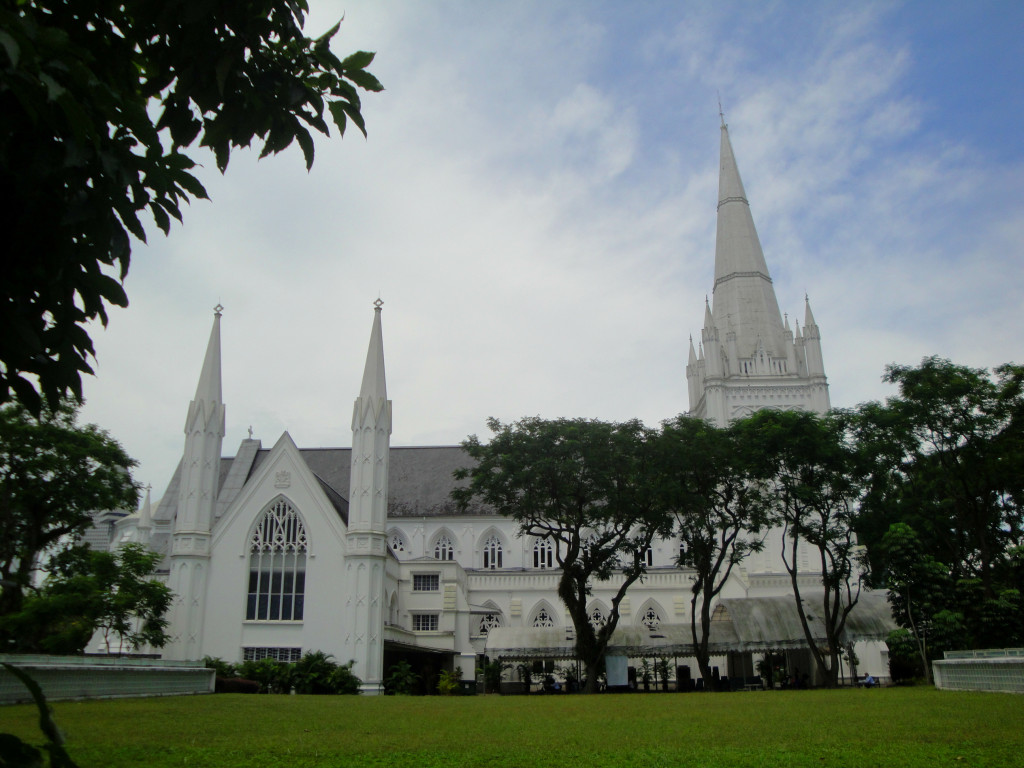
Surrounded by Singapore’s glittering malls, the white spire of St. Andrew’s Cathedral sticks out like a grandmother at a sweet sixteen party. And much like a grandmother, the church has been witness to a long and layered history. But rather than becoming obsolete amidst the rapidly developing shopping centers and trendy restaurants, St. Andrew’s has proven itself to be quite capable of evolving and adapting without losing sight of its mission.

In many ways, St. Andrew’s is a bastion of Singapore’s history. Though there is no burial ground at the church site, plaques line the walls of the main hall in memory of soldiers, nurses, and civilians from almost every conflict: from the mutiny of February 1915 through the Pacific War, during which the cathedral acted as an emergency hospital before the country fell to the Japanese in 1942. Regardless of one’s religious affiliation, it is hard to deny the important role St. Andrew’s has played throughout this island nation’s past. For example, in 1842 the church assisted in founding what is present-day St. Margaret’s, the very first all-girls school in Southeast Asia, despite widespread opposition to the young girls’ removal from slavery and to the education of women in general.

The story of St. Andrew’s began in 1823 when Sir Raffles chose the site of the cathedral to be the location of Singapore’s first Anglican church. The building was completed a decade later and named for the patron saint of Scotland due to the large contributions made by local Scottish businessmen. However, this original building was struck by lightning twice in 1838 and, deemed unsafe, it was demolished. The present building was consecrated in 1862, which made last year the cathedral’s 150th birthday. Although Christian congregations have recently been shrinking worldwide, St. Andrew’s still has a robust community of between 5,000 and 6,000 regular patrons who attend services at a variety of times in a variety of languages. During the late 1990s St. Andrew’s actually found itself unable to accommodate the growing volume of churchgoers, but since the site had been declared a national monument in 1973, no additions could be made to the church structure. Therefore it was decided that an underground worship hall would be built to service the growing congregation. Completed in 2005 the Cathedral New Sanctuary is a modern chapel kept cool underneath the Welcome Centre, which is snuggled up to the City Hall MRT entrance.

Like Singapore itself, the church is an amalgamation of international influences and it has consistently integrated both new technologies and diverse cultures. The neo-gothic architecture is distinctly English. The reredos (an ornamental alabaster screen with a mosaic depicting the birth of Jesus) was crafted in Italy. The sturdy wooden pulpit was made in Sri Lanka back when it was still called Ceylon. Each page of the Bibles nestled in the pews is split in half with English on one side and Mandarin on the other. St. Andrew’s is over a century older than the Republic of Singapore and acts as a living chronicle of the nation’s history. Hopefully this dynamic cathedral will continue to be an indomitable part of the cityscape for many years to come, regardless of the gleaming skyscrapers that spring up around it.

Singapore American logo